These MIT Hackathon Winners Built an AI That Can Control Your Body
At the MIT Hard Mode 2026 hackathon, a six-person team built Human Operator in 48 hours — a wearable AI that uses electrical muscle stimulation, computer vision, and Anthropic's Claude API to physically guide a user's hand and wrist through movements in real time. The science fiction framing is the least interesting thing about it.
Jayanth Kumar
The project has a one-line description that stops people mid-sentence: "We gave AI a body."
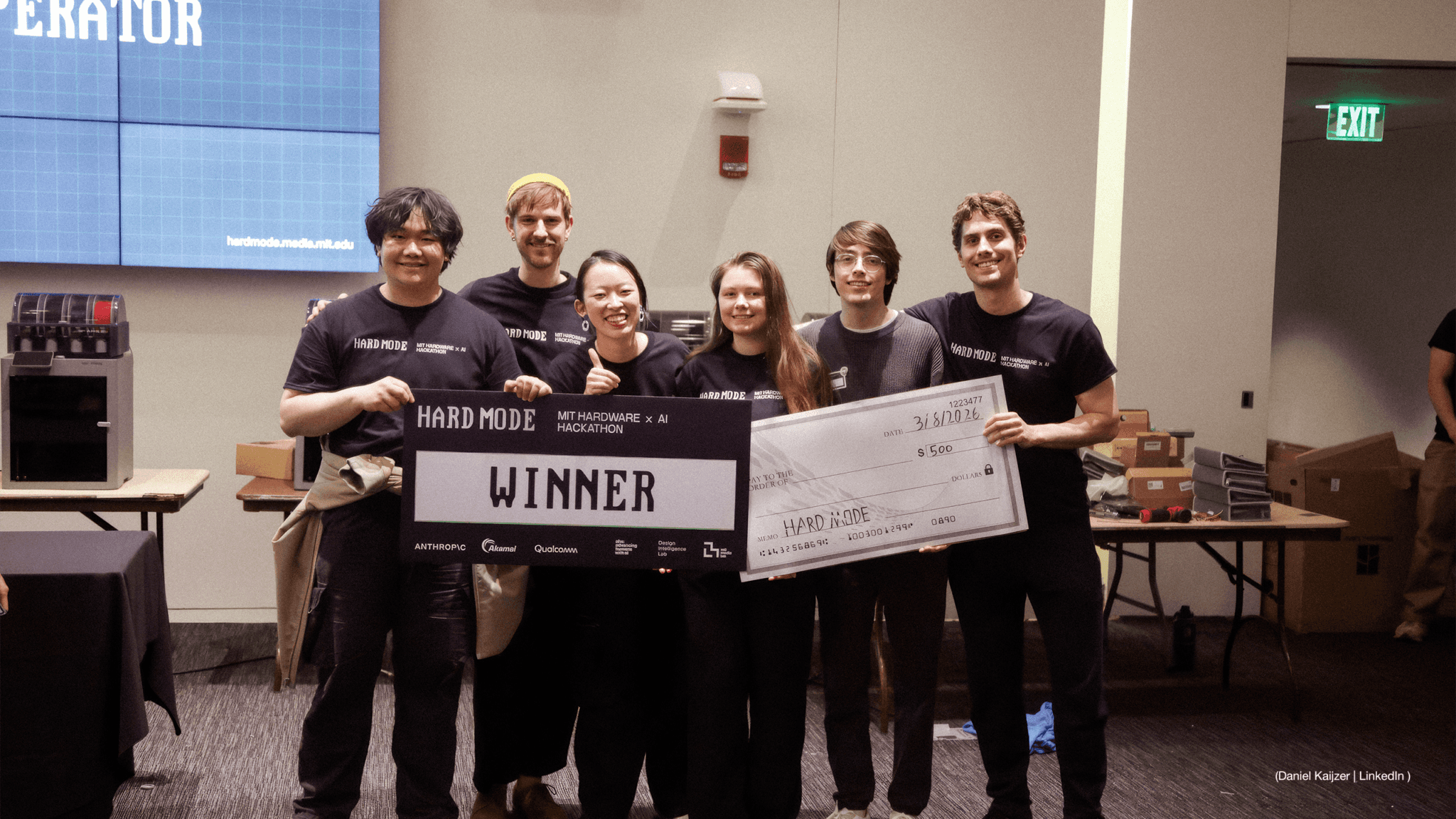
Human Operator, built by a six-person MIT team Peter He, Ashley Neall, Valdemar Danry, Daniel Kaijzer, Yutong Wu, and Sean Lewis over 48 hours at the MIT Hard Mode 2026 hackathon, is a wearable device that uses artificial intelligence to physically guide a user's hand and wrist movements through electrical muscle stimulation. It won first place in the hackathon's Learn Track, which focused on intelligent physical systems that can sense, adapt, and respond to people in real time.
The technical architecture is more grounded than the headline suggests. Human Operator combines three components: a head-mounted camera that feeds a continuous visual stream of the user's environment into a vision-language model; voice input that the user speaks aloud to issue commands; and Anthropic's Claude API, which processes both the visual context and the voice command to determine what physical movement is required. That determination is then translated into electrical pulses delivered through EMS (electrical muscle stimulation) electrodes attached to the user's wrist and fingers, which contract specific muscles to guide the hand through the intended motion.
In demonstrations shared by the team, the system successfully guided users to wave, play a sequence of piano notes, and form an "OK" hand gesture all through AI-directed muscle stimulation, with the user providing no voluntary motor input for those movements. The team describes it as an "augmentation tool" designed to help people learn or perform actions they couldn't manage unaided, rather than a system that takes over against a person's will.
The application space is real and already being explored in academic research. Rehabilitation is the most immediate: for someone recovering from a stroke or a neurological injury, a system that can guide a limb through the correct motor pattern essentially teaching the nervous system through repetition — could complement existing physiotherapy in meaningful ways. EMS technology is already FDA-regulated and widely used in clinical and consumer settings; the novel element here is the AI layer that interprets context and generates commands in real time, rather than requiring pre-programmed sequences.
The team draws on prior research from the Human Computer Integration (HCI) Lab at the University of Chicago and published work on neuromuscular interfaces and generative muscle stimulation — a body of academic work that has been building quietly at the edges of embodied AI for years. Human Operator is in that lineage: a hackathon prototype with serious intellectual roots.
The ethical and regulatory questions are genuine and not yet resolved. EMS applied incorrectly can cause muscle fatigue, discomfort, or injury. A consumer wearable controlled by a large language model occupies a grey area that current regulatory frameworks weren't designed for. The FDA regulates EMS as a medical device category, but an AI-directed version sits between medical device and consumer AI product in ways that don't fit neatly into existing frameworks. The MIT team has been explicit that the current prototype is exploratory not a finished product, and not something to deploy without robust safety engineering.
What Human Operator represents, more than a product, is a proof of concept for a new class of AI interface. Anthropic's Claude, which powers the command interpretation layer, already has the ability to control software on a Mac clicking, typing, navigating applications on a user's behalf. Human Operator extends that same principle from the digital world into the physical one. The screen is no longer the boundary. Built in 48 hours with accessible components, by a student team, at a weekend hackathon that is perhaps the most striking fact of all.
About

Explore Topics