>
>
Meet the Only Black CEO in the FTSE 250 Leading Dr Martens Out of Its Post-$4B IPO Slump
Meet the Only Black CEO in the FTSE 250 Leading Dr Martens Out of Its Post-$4B IPO Slump
Dr Martens went public in 2021 at roughly $4 billion, and the share price has since fallen more than 84%. The brand didn't need a cost-cutter — it needed someone who understood why people love it. Ije Nwokorie, a former Apple executive and brand strategist who became CEO in January 2025, is now leading a turnaround that just delivered 61% profit growth. He is also the only Black CEO in the FTSE 250.
Jayanth Kumar
Dr Martens is one of the most culturally durable brands in British history. The boot with the yellow welt and air-cushioned sole has been adopted and re-adopted by skinheads, punks, New Wavers, grungers, goths, and streetwear enthusiasts across more than six decades each generation claiming it as its own without diminishing the next generation's ability to do the same. That kind of cultural elasticity is almost impossible to manufacture. It requires a product and an identity sturdy enough to carry meaning without prescribing it.
What Dr Martens couldn't survive, at least not easily, was its own IPO.
The January 2021 flotation on the London Stock Exchange valued the brand at roughly $4 billion, arriving on a wave of post-pandemic optimism and genuine consumer demand. What followed was a sustained and painful reckoning. Revenue growth slowed. The crucial US market underperformed badly — wholesale revenues fell significantly year on year. Margin pressure accumulated. Profit warnings followed. By early 2026, the share price had fallen roughly 84% from its IPO level, a decline severe enough to raise questions about the long-term strategic direction of the business.
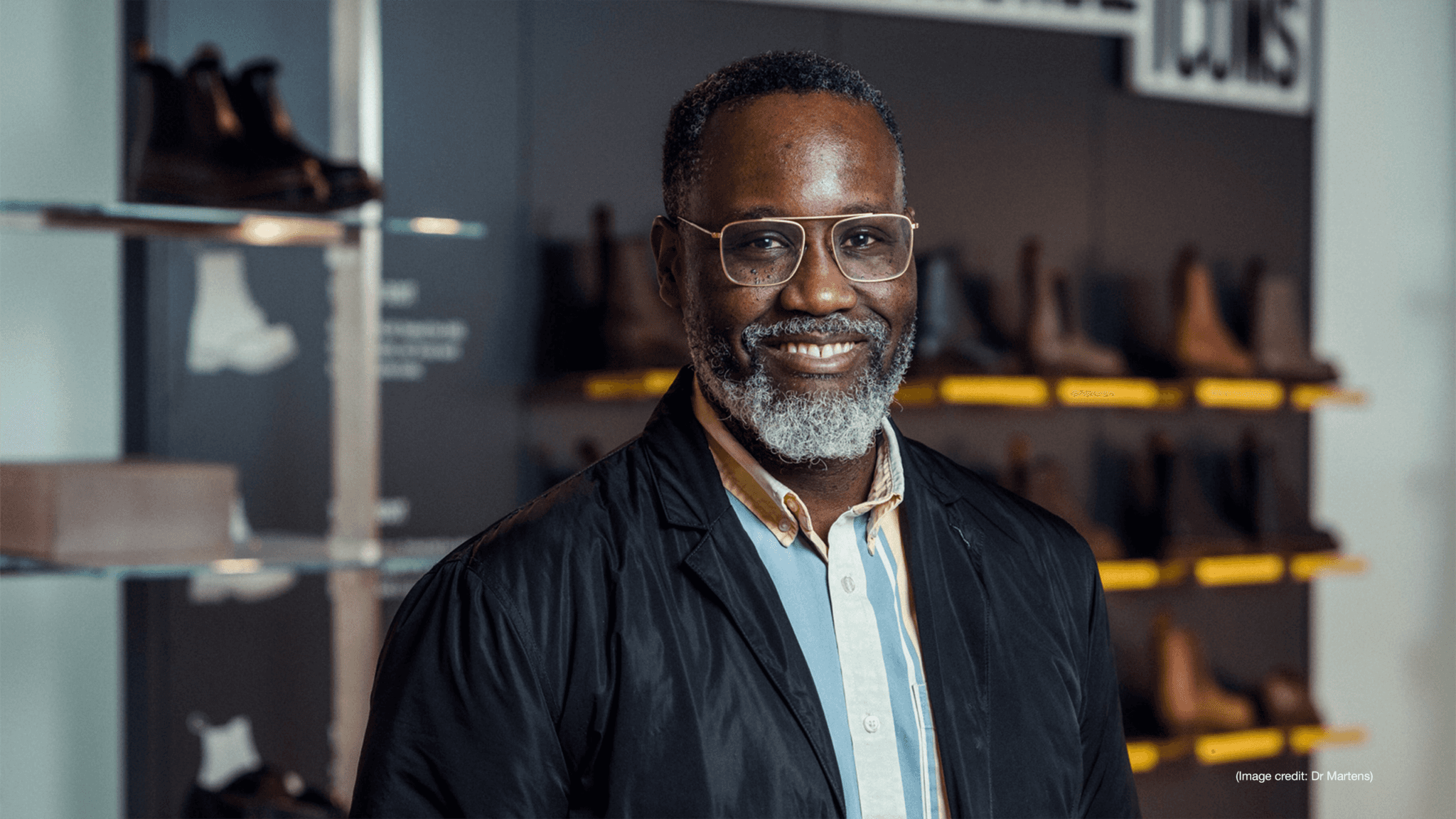
Into that environment came Ije Nwokorie, who took over as CEO on January 6, 2025, and in doing so became the only Black CEO currently leading a FTSE 250 company.
Nwokorie's background is unusual by the standards of corporate turnaround appointments. He is not a cost-restructuring specialist or a private equity operator. His career has been built at the intersection of brand, design, and consumer experience. He spent eleven years at global brand consultancy Wolff Olins, eventually as CEO, leading offices across London, Dubai, New York, and San Francisco. He then moved to Apple, where he served as Senior Director of Apple Retail a role that gave him direct experience of how one of the world's most powerful consumer brands manages the physical experience of its products. He joined Dr Martens as a non-executive director, then became Chief Brand Officer in early 2024, before being named CEO.
His predecessor Kenny Wilson's departure followed a turbulent six-year tenure marked by the IPO euphoria and its prolonged aftermath. Wilson acknowledged that after six years, the timing was right to hand over. Nwokorie's appointment was widely read as a signal that the board believed the brand's problem was fundamentally perceptual and cultural rather than operational that Dr Martens needed to be loved again before it could be managed back to growth.
The strategy Nwokorie has pursued reflects that diagnosis. Rather than cutting his way to profitability, he has focused on what he calls a "consumer-first" operating model shifting away from the channel-led, promotion-heavy approach that had damaged brand perception and eroded margins, toward building genuine desire for the product. He expanded the brand's focus beyond boots into shoes and sandals, arguing that the previous narrow focus had failed to capture available demand. He cut back discounts and promotions deliberately, accepting short-term revenue weakness to rebuild price integrity and margin quality.
The early results have been encouraging. Dr Martens' full-year 2026 results, published in May 2026, showed a 61% increase in adjusted pre-tax profit to £55 million, from £34.1 million the prior year despite a 2.9% fall in reported revenues. The Americas, which had been the brand's most troubled region, returned to growth. Nwokorie's assessment was that the business had made real progress, with "a lot more to go after."
The share price, despite the profit improvement, remains far below its IPO level. The gap between operating progress and market valuation is the challenge that remains. But for a brand that has survived every cultural moment of the last sixty years by being stubborn about what it is, the appointment of a CEO whose core skill is understanding why people love things may turn out to be exactly right.
About

Explore Topics