>
>
He Sold a Startup for $160 Million in His 20s. Now He Spends His Days on College Campuses Asking Students What They're Building.
He Sold a Startup for $160 Million in His 20s. Now He Spends His Days on College Campuses Asking Students What They're Building.
Alex Monahan isn't doing motivational speaking. He's deploying the same skills that made him effective as an operator in front of an audience that can learn from the exchange in real time.
Jayanth Kumar
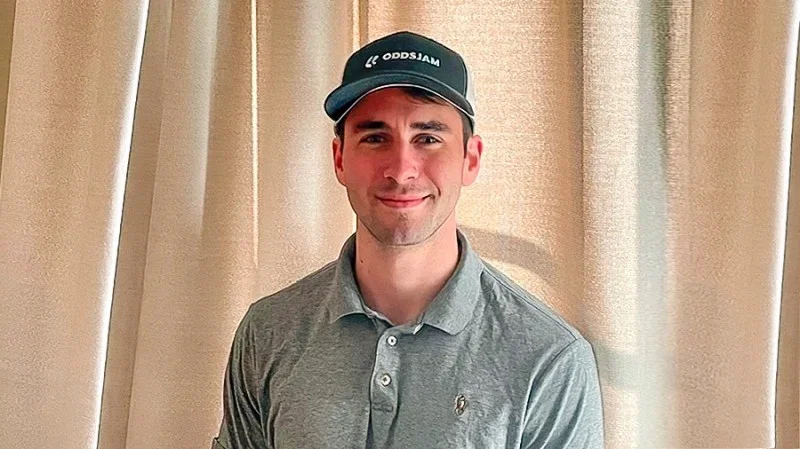
By the time Alex Monahan sold OddsJam in a deal worth up to $160 million, he had entered the small category of founders whose names travel with a number attached. What makes him interesting isn't the number. It's where he chose to show up after the headlines faded.
Monahan spent much of his 20s building OddsJam a real-time sports betting odds platform into a serious business in a category where speed, pricing, and trust all lived on a knife edge. In December 2024, Gambling.com Group agreed to acquire the parent company, Odds Holdings, for up to $160 million, with $80 million upfront and the remainder tied to performance through the end of 2026. The deal closed as planned in January 2025.
But even after a nine-figure outcome, Monahan kept building in public. He had developed a habit of streaming late into the night, treating the process of building as content unusually comfortable with transparency, unusually consistent in showing his work. The acquisition didn't change that. It gave it a bigger stage.
In the months that followed, Monahan started showing up on college campuses UCLA in particular filming conversations with students pitching business ideas. The posts that followed didn't read like thought leadership. They read like field notes. He gave $1,000 to the student with the best idea after one visit. He became a first customer for two others.
What grabs him, based on the interactions he's shared publicly, isn't the pitch. It's the evidence. One widely shared clip highlighted a student who arrived with a physical sample, pricing logic, customer acquisition thinking, and a waitlist of 6,000 people. Monahan's commentary made the point clear: there's a meaningful difference between talking about a startup and arriving with proof that one has already started.
The questions he keeps returning to are deliberately unglamorous: Who is this for? What have you built? How are you getting users? What proof do you have that anyone cares? They're the same questions that decide who and what survives in the early days of any company.
What makes the arc coherent is the continuity. The sale gave Monahan resources and credibility. His online presence gave him distribution. The campus pitch sessions give him a place to deploy both passing down the same pattern recognition and traction-first thinking that made him effective as a founder, in front of an audience that can act on it in real time.
About

Explore Topics